

I lived in Japan for 18 years and still go back every year, for family and work, so making sure I have a Japan travel eSIM that works reliably is high on my list. The other of course is eating sushi as soon as possible after landing! As there are many eSIM providers, my team in Japan and I have been trying them out one by one, so that we can provide reviews based on our actual experiences for our readers and friends. Nomad eSIM has strong Trustpilot reviews, so we wanted to see how easy it was to set up, and then ran speed tests in both Tokyo and Hiroshima.
So how did it do? Well the good news is that we got 50 Mbps on 5G in Hiroshima, and then 33 Mbps for our Shibuya test. In terms of price it’s also competitive, and you can buy 10GB of data for just over £12 with their current sale. Below, in the rest of our Nomad eSIM review, you can read our full results and how it compares with Airalo and Ubigi.
Nomad provided our eSIMs free of charge for this review. We chose what to test, and everything here is our own honest opinion. This article contains affiliate links which help us pay for our own eSIMs for future tests, at no extra cost to you!
What is Nomad eSIM and how does it work?
As with some of the other global eSIM providers, Nomad eSIM covers more than 200 destinations, so it’s worth keeping in mind for your other trips abroad, and you can buy their data packages either through its app or website. I know some people aren’t keen on having another app on their phone, but I prefer to get the app as it’s smooth to install the eSIM and then you can keep an eye on how much data you have left at a glance. Also, like other eSIMs you can install it right before you board your flight, and it’ll pick up a local network when you land.
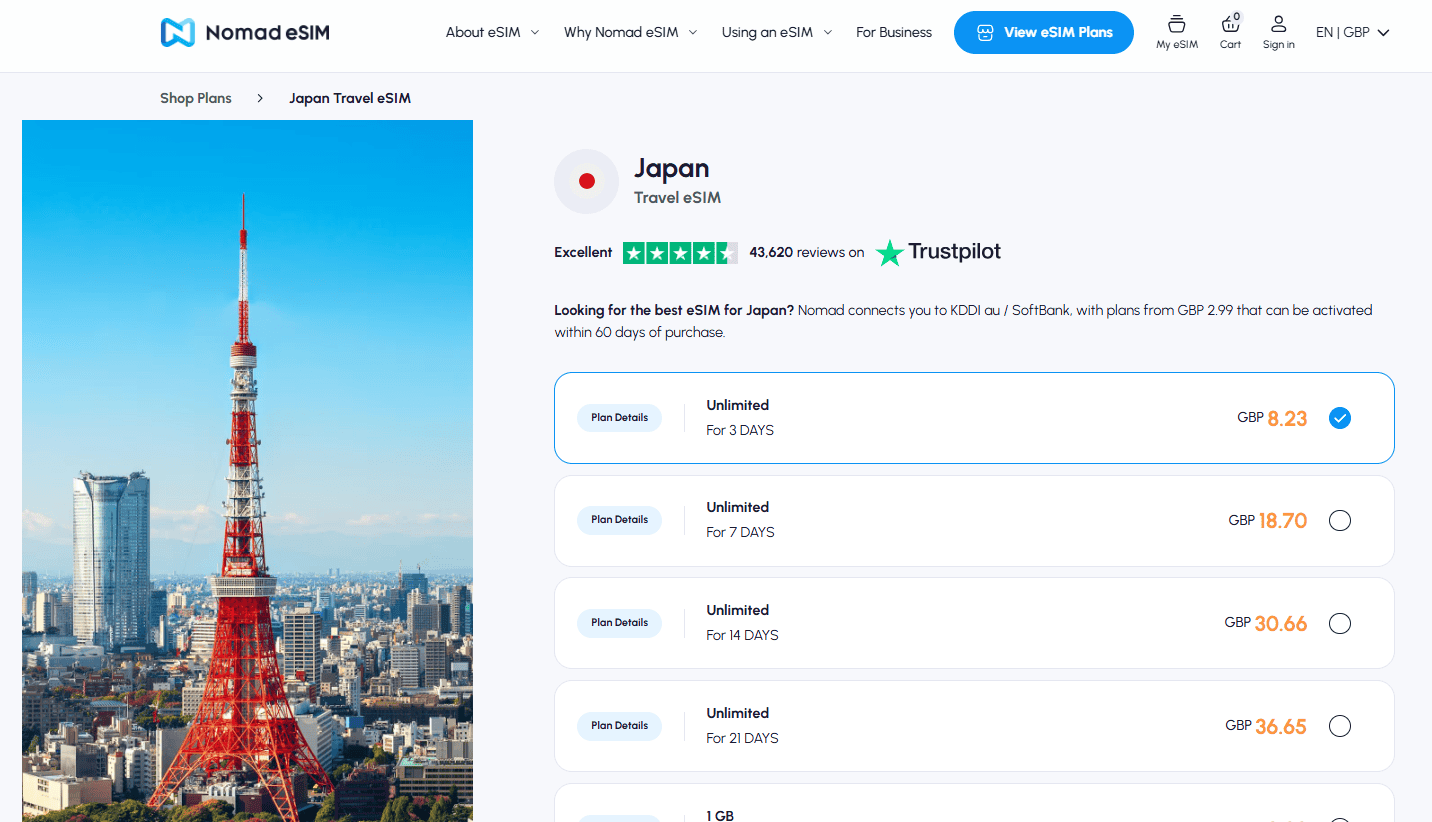
For Japan, there are fixed data plans all the way up to 50GB, starting at £3.02 for a 1GB plan, and then there are unlimited data plans from 3 to 21 days, that start at £8.31. Something useful to know is that Nomad eSIM runs on KDDI au and SoftBank, which are two of the major Japanese phone networks. I used to have SoftBank when I lived in Japan so can vouch for it, and I wish my current UK provider had the same reliability!
Once you install a plan you have a 60 day period to use it, but the data usage only starts to be counted once you’re in Japan and connected to a Japanese network. If you run low on your plan, you can always buy an add-on in the app, and it tops up the same eSIM. For those of you lucky to travel across Asia, Nomad also has regional fixed data plans that cover China and Korea as well as Japan, and which start at £3.02 for 1GB.

Nomad eSIM Review: Our Experience in Japan
Globally, Nomad eSIM got ranked as the fastest travel eSIM in Ookla’s (the company behind Speedtest) Q2 2026 analysis, where it was a fraction ahead of Ubigi. Naturally, we wanted to see how it would perform in Japan, so we tested it at Shibuya Crossing, one of the busiest parts of Tokyo, and then in Hiroshima, right in front of the A-Bomb Dome.
In both locations, we ran speed tests on Fast.com, and checked how quickly we could scroll through Japan travel websites or play YouTube videos. Here are the results.
Speed Test Results: Shibuya Crossing in Tokyo
We chose Shibuya Crossing as it’s an instantly recognisable place in Tokyo, and it’s likely that you may want to go there especially if it’s your first trip to Japan. When we tested, we saw 33 Mbps download speeds and 38 Mbps upload speeds on 5G, which was fine when checking websites online and also when opening up YouTube and playing videos. Remember that this is one of the most crowded parts of Tokyo, and where mobile networks are going to be under more pressure.
Speed Test Results: Hiroshima
In Hiroshima, we also chose a very well-known location for our test across from the A-Bomb Dome. Here we saw a fast 50 Mbps download on 5G, meaning web pages loaded instantly as did YouTube without any waiting around. We came back later to film another test, and this time the phone signal had dropped to 4G, but the connection was good with a 9.3 Mbps upload and latency as low as 48 ms, meaning there was barely any delay.
Where your data goes
In Shibuya, our speed test showed the connection was routed through Singapore, with latency of 85 ms, rising to 158 ms under load. That’s a bit technical so just to explain it means when the connection was busy, the response time increased and there was slightly more delay but still not noticeable in our test. In Hiroshima, the connection came through a Japanese IP, so be aware that routing can vary depending on where and when you connect.
Pricing and Plans for Japan
As of 3rd October 2026, Nomad’s Japan plans start at £3.02 for 1 GB, and you can see the price per GB drops with the larger data plans, going down to 53p on the 50 GB plan. Prices do change and the current sale on 10GB and 20GB plans may not continue in the future, so please check the current prices before you buy.
If you’d rather not count gigabytes, Nomad also has unlimited plans for Japan, from 3 days (£8.31) to 21 days (£37.01). The longer the plan, the cheaper each day gets, down to around £1.76 a day. Just like many other eSIM providers, the unlimited plans do have a limitation, as you get a daily allowance of high speed data, and once that’s used up, your speed drops to 512 kbps until it resets 24 hours later.
So which should you pick? For a typical one or two week trip where you’re using maps or travel apps to get around, along with some light social media use, the unlimited plans could work, especially if you can wait to use WiFi for any streaming. However, we went for the fixed 10GB plan in Tokyo and the 20GB plan in Hiroshima because we know we’re heavy data users in Japan (and potentially can’t help Instagram scrolling).
We also film and upload content most days, and we didn’t want to hit a daily limit and get slowed down halfway through. If you’re working remotely or posting reels, the 20 GB and 50 GB plans are also worth considering. Currently, new users can get a free 1 GB trial too, which is a handy way to try Nomad before you buy a larger plan.
How to install and activate Nomad eSIM for Japan
Setting up Nomad eSIM takes a few minutes, and for us the best time to do it is at home the day before you fly, while you’re on a reliable WiFi connection. We have been caught out once trying to install another eSIM provider after landing at Haneda airport in Tokyo, and found we could not connect until we were outside the airport.
- Check your phone works with eSIM. Your phone needs to support eSIM and be unlocked. Most iPhones from 2018 onwards and recent Samsung and Google Pixel phones are fine, and Nomad has a full compatibility list on its site.
- Buy your plan. Choose Japan in the Nomad app or on the website and pick your data plan.
- Install the eSIM (internet Connection required). If you bought your plan in the Nomad app, the easiest way is to tap Add automatically and follow the instructions. You can also scan the QR code from your email by going to Settings, then Mobile Service, then Add eSIM.
- Turn it on when you land. In Settings, switch the Nomad line on, turn on Data Roaming for it and set it as your line for mobile data. Your phone will then connect to a Japanese network, and your plan starts once it’s connected.
- Keep your home SIM for calls only. Leave your normal SIM on for calls and texts if you need them, but make sure it isn’t being used for data, or you could end up paying your home network’s roaming charges. We usually turn ours off to avoid this from happening.
When it came to activating Nomad eSIM, everything went smoothly when using the App. As you often need a second screen (such as a laptop) for the QR Code method, we recommend using the App method, which only took us a few minutes.
Which is better for Japan: Nomad eSIM vs Airalo vs Ubigi?
We found that the biggest differences between these eSIM providers are the networks they choose as their main supported ones, how each app works, and how they performed for us.
Nomad eSIM is a good option if you want a wide choice of fixed and unlimited plans on KDDI au and SoftBank, with speeds that held up well as we found in our Shibuya and Hiroshima tests.
Airalo makes sense if you already use it for other trips and like keeping everything in one app. We first started using Airalo as an eSIM option although we found it’s not always the cheapest now.
Ubigi could be worth considering if you prefer the NTT Docomo network as one of the main choices, or you like the safety net of topping up even when your data has completely run out.
Prices checked on 3 October 2026 on Airalo’s Japan page. Ubigi details from Ubigi’s Japan plan page.
Pros and cons

Pros
- Fast 5G in our tests: 50 Mbps in Hiroshima and 33 Mbps in Shibuya, which is one of the busiest spots in Tokyo.
- Good value on bigger plans: the more data you buy, the cheaper each GB gets, down to around 50p per GB on the 50 GB plan.
- Competitive Unlimited option: a week of Unlimited data costs around £2 less than at Airalo.
- Two Japanese networks for all plans: KDDI au and SoftBank both have strong coverage in cities and in the countryside areas.
- Flexible timing: you have 60 days to start your plan, and it only begins when you connect in Japan.
- Hotspot supported: handy for sharing with a laptop or a travel partner.
Cons
- Data only: there’s no Japanese phone number, which sometimes is required for some businesses or organisations who don’t provide another way to get in touch.
- Routing isn’t always local: in Shibuya our connection went through Singapore, which pushed latency up to 85 ms. This is still reasonable, and we didn’t notice it when testing.
- Unlimited plans slow down: once you use your daily high speed allowance, speeds drop to 512 kbps until it resets.
- One install only: a Nomad eSIM can only be installed once, so if you delete it by mistake, you’ll need to contact support to sort it out.
Final verdict: is Nomad eSIM worth it?
Yes, our test speeds were good on 5G in both Tokyo and Hiroshima. I like how their website is easy to navigate and presents enough options so you’re not overloaded with fixed and unlimited plans to choose from, but still get a really nice range. The live chat experience was a nice surprise for me as well. You do start out with a bot, but after asking my non-generic question, a real customer support agent replied within a minute and answered 3 questions pretty much straightaway.
The only real reason to look elsewhere is if you need a Japanese phone number, since Nomad eSIM is data only. Also a small thing was that our Shibuya connection did go through Singapore, but we only spotted that in the speed test results, and a 2024 study found Airalo does the same, so we know this kind of routing does happen with travel eSIMs.
Overall, we had a good experience using Nomad eSIM, and I’d happily use it when next travelling in Japan. Our readers can also receive a special 15% discount code for plans above $5USD (T&Cs apply) by using the promo code ‘BESTJAPANESE15‘.
For those who would like to know more about travel related posts in Japan, we’ve got you covered in our Travel section. Meanwhile if you’re looking to add Hakone into your Japan trip, make sure to check out our Mishima city & Hakone 2-day itinerary.
All information is accurate as of the date of publishing the article, but we would recommend checking all the relevant websites for the latest information.
For disclosure, this is sponsored content, however the opinion given here are entirely our own from our experiences testing in Japan.
FAQs for Nomad eSIM

Is Nomad eSIM good in Japan for Speed?
Yes. In our 2 tests, it gave us 50 Mbps on 5G in Hiroshima and 33 Mbps in Tokyo, and it also worked smoothly for searching websites and streaming videos.
Which networks does it use in Japan?
Nomad eSIM’s Japan plans run officially on KDDI au and SoftBank, two of Japan’s main mobile networks. I personally used to have SoftBank when I lived in Japan and found it to be a reliable network.
Does it give you a Japanese phone number?
No. Their Japan plans are data only, so you won’t have a Japanese number for calls or texts. However, you can use apps like WhatsApp or Facebook Messenger to call friends and family who also have accounts. While there is no phone number provided in Japan, you can get one with some of its UK plans.
Is Nomad eSIM unlimited data really unlimited in Japan?
Yes, but high speeds are capped daily. You get 2 GB of fast 5G/4G data each day. Once you reach that 2 GB limit, your speed drops to 512 kbps until the 24-hour cycle resets. At that reduced speed, WhatsApp messages and Google Maps still work, but streaming videos on apps like Instagram, TikTok, and YouTube are likely to take time to load or may freeze.
Can you use it as a hotspot in Japan?
Yes. Nomad eSIM supports hotspot and tethering, so you can share your connection with a laptop, tablet or another phone.
When should I install my Nomad eSIM?
Install it before you leave home, while you’re on WiFi. Your plan doesn’t start until your phone connects to a network in Japan, so don’t worry about using data or days on your unlimited plan. Also, you’ll have 60 days from purchase to use your plan.
How much does it cost in Japan?
When we checked in October 2026, fixed data plans started at around £3 for 1 GB, with 10 GB for around £12. Unlimited plans ran from 3 days (around £8) to 21 days (around £37).
Is Nomad legit?
Yes. Nomad has a 4.3 rating from more than 44,000 reviews on Trustpilot, and it’s rated 4.8 on the App Store and 4.7 on Google Play. Our plans worked as expected when testing them, and we had no issues when installing or activating the eSIMs either.
What are the T&Cs for using our 15% Nomad eSIM discount code?
Our readers can get a special 15% discount for fixed plans using the code ‘BESTJAPANESE15‘. Please note that Nomad’s standard discount terms and conditions apply to this code. These include them being single-use per user and not applicable to plans under $5USD, on sale plans, add-on data, and unlimited plans. You can see full details of their promo code policy here.

